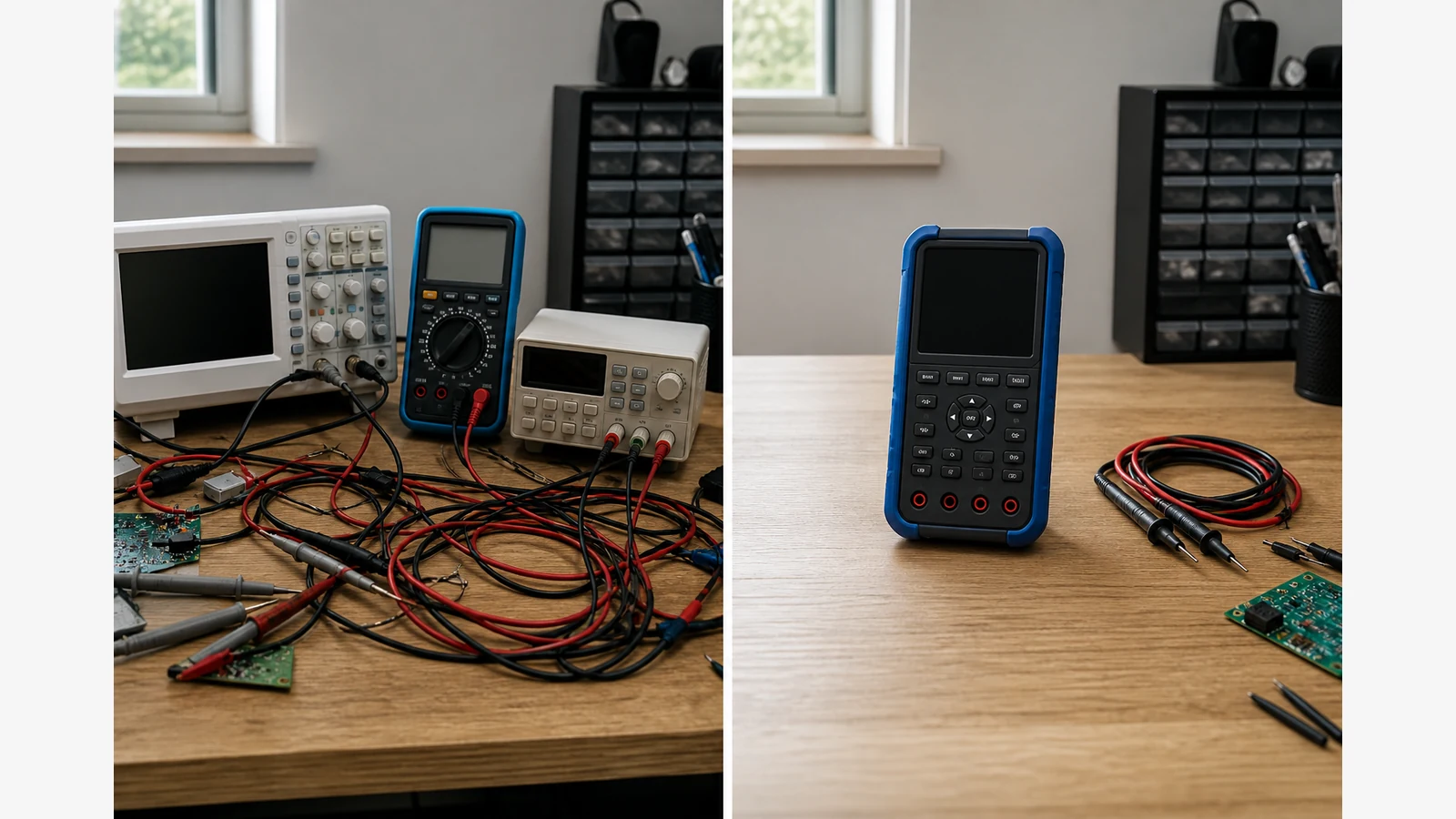
Handheld Oscilloscope and Multimeter UK
If you are pricing a separate oscilloscope and a True RMS multimeter—plus two chargers and two footprints—a single handheld can be the clearer buy. For many UK makers, repair benches and field LV kits, a handheld oscilloscope and multimeter shoppers should consider is a single-channel 10 MHz combo that states a single 10 MHz channel and a 9999-count True RMS meter.
Direct answer: when one kit beats three
Buy the handheld scope and meter when your work is everyday electronics, microcontroller debugging, PSU ripple checks, and portable LV diagnostics—and when desk space or travel weight matters. Buyer guides for 2026 continue to frame handheld scope-meters as space and cost savers, with ~50 MHz a common value tier. Keep separate premium instruments when you live in RF, deep-memory digital work or calibrated metrology.
UK value math beyond the sticker price
- Bench space: one footprint instead of three stacked boxes
- Total spend: one purchase versus three instruments and spare leads
- Charging and travel: one rechargeable body for van or makerspace bags
- Context price cue: public UK listings for the ZOYI ZT-702S around £98.46 including VAT with free UK delivery messaging illustrate the value tier—always re-check the live page
The meter on this site is the ZOYI ZT-702S: one 10 MHz channel and a 9999-count True RMS meter, with a fixed 3 V / 1 kHz square-wave port for probe compensation.
Must-check features before you click buy
- One 10 MHz channel when the job is sensors, PWM and slower supplies
- True RMS multimeter functions you will actually use
- A fixed square-wave port so you can compensate the probe before you measure
- The scope input limit printed on the meter, and probe ratings you can read
- UK delivery, returns (for example a 30-day window) and warranty language you can rely on
Enough-for-most versus specialist-only jobs
Enough-for-most: Arduino/ESP32 debugging, control-board repair, everyday ripple observation, sensor LV checks, and decluttering a field bag. Specialist-only: precision RF, advanced protocol analysis, CAT IV industrial plant work, or anything requiring accredited calibration certificates. A handheld scope and True RMS meter in one body earns its place in the first list when the bandwidth matches the job.
Who should not buy a combo
Skip the combo if you already own excellent discrete tools, if you need a large bench display all day, or if your manager specifies industrial ScopeMeter-class equipment. Fear that “three functions means three mediocre ones” is fair—answer it by matching published specs to your jobs, not by assuming every combo is useless.
Next step
See the ZOYI ZT-702S on the product page. If you are weighing one handheld against a separate scope, meter and generator, start from the work you actually do. Everyday electronics, microcontroller boards, small power supplies and van repairs rarely need three boxes. They need a trace you can see and a number you can trust. The ZOYI ZT-702S on this site is that pairing: one 10 MHz channel and a 9999-count True RMS meter. English menus, a 2.8-inch colour screen, USB-C charging, and a spare oscilloscope probe set in the box. The side port is a fixed 3 V / 1 kHz square wave for compensating the probe, which is what you want before you decide a flat line is the circuit rather than the lead. Scope input stays within 150 V peak. Higher voltage checks belong on the meter ranges, inside the ratings printed on the instrument. A second channel is useful when you must see a clock and a data line together. This meter does not do that. A swept signal generator is useful when you must walk a filter through a band of frequencies. This meter does not do that either. What it does do is remove the second bag. Charge the cell, set the probe and the meter to the same X1 or X10, compensate on the square-wave port, then move to the board. Use the scope for shape, ringing and rough timing. Use the meter for voltage, current, resistance, continuity, diode, capacitance, frequency and temperature. Keep the price check honest: the live page shows £98.46 including VAT, with UK delivery and a 30-day returns window. Re-read that page when you order, because a guide is not the till. If the job later grows into RF, high-speed digital buses or certified calibration work, buy the bench instrument for that job and keep the handheld for the calls where one pair of hands and one small case is the whole point. Walk the decision in order. List the three measurements you repeat every week. If two of them are a voltage number and a waveform shape, one ZT-702S covers the list. If one of them is comparing two signals at the same instant, keep a two-channel scope on the bench and use the handheld only for the visit. Pack the spare probe in the same pouch as the meter so a broken tip does not end the job. After charging, confirm the square-wave port still looks like a square before you leave. On site, write down the volts per division and the timebase you used, because a photo of the screen without those settings is hard to explain later. The 9999-count meter is there for the number beside the picture: continuity when a joint looks dull, diode drop when a rail clamp is suspect, and temperature when a part is too hot to touch. None of that requires a second instrument in the bag.ZT-702S handheld ScopeMeter detail page. Compare buying criteria with FNIRSI vs Hantek handheld comparison tips, and see maker-focused fit in oscilloscope for Arduino UK. Existing multimeter explainers such as multimeters explained still help if you are building fundamentals first.
FAQ
Will one handheld feel limited?
It trades peak performance for one case you can carry. For routine electronics it is often enough. Specialist lab work still belongs on a bench instrument.
What if I outgrow it?
Keep the handheld for travel and buy a dedicated bench scope later—the combo still earns its keep as a meter-plus-scope pocket tool.
Is ~£98 a reliability guarantee?
No price alone guarantees longevity. Use returns windows, warranty text and honest specifications as your risk controls.