Multimeters Explained: A UK Buyer's Guide
Choose a multimeter for electronics, Arduino, automotive or electrical work by checking safety category, input protection, functions, leads and accuracy.
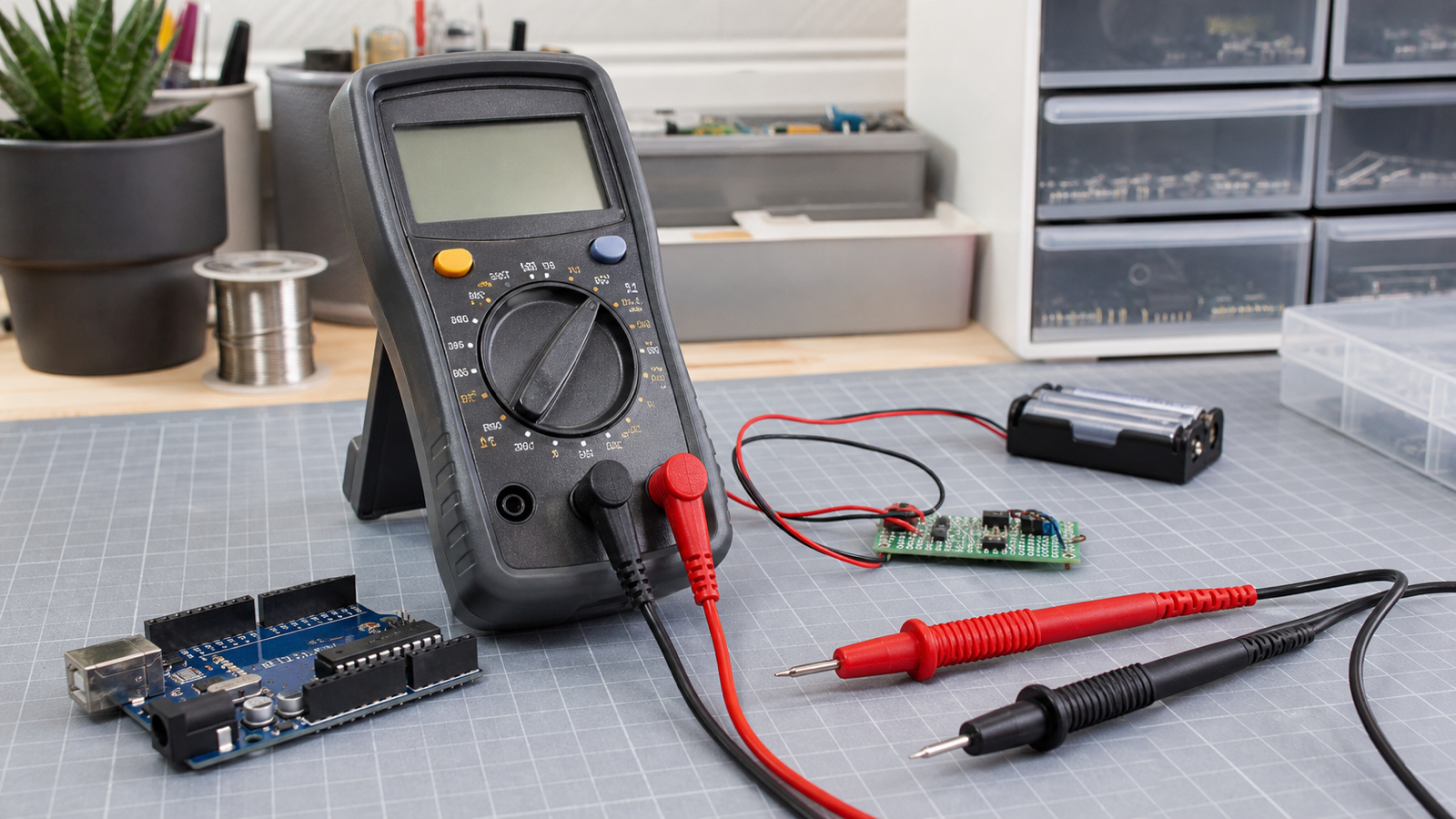
The safest multimeter is the one whose input protection, leads and measurement category match the circuit in front of you. A long feature list does not make a meter suitable for every job, and a high maximum-voltage number is not a substitute for a credible safety design.
For Arduino boards, small battery projects and basic continuity checks, a straightforward meter can be enough. Automotive diagnostics may add current, frequency, duty-cycle or temperature needs. Work on fixed electrical installations is a different risk class and should be left to people with the competence, procedures and equipment for it.
This guide helps you write a sensible shortlist. It does not teach live working or qualify anyone to test a UK mains installation.
Start with the work, not the display count
Write down the circuits you genuinely expect to measure. Useful groups are:
- low-voltage electronics, sensors and microcontroller boards;
- household batteries, cables, switches and unpowered continuity checks;
- 12 V or 24 V vehicle systems;
- appliances and powered equipment;
- fixed wiring, distribution boards or industrial systems.
Those groups are not interchangeable. The energy available from a fixed installation can be far greater than the energy in a breadboard circuit, even when two readings look modest. If your list reaches fixed wiring or three-phase equipment, product selection is only one part of the problem: competence, isolation, proving dead, safe systems of work and suitable personal protection matter too.
The Health and Safety Executive’s GS38 guidance is aimed at people using electrical test equipment on low-voltage systems. It says work should be carried out dead wherever possible and covers probes, leads, fuses and test-equipment construction. HSE’s broader electrical safety guidance also warns that a multimeter, which can be set to the wrong function, is not the recommended instrument for proving dead on low-voltage systems.
Understand measurement categories
CAT markings describe the transient environment for which a meter and its accessories are designed. They are not a ladder of general quality and they do not simply mean “maximum voltage”. A correctly specified CAT III instrument may be intended for a different location from a CAT II product bearing the same voltage figure.
Check the category and voltage together, then confirm that the meter, probes, leads and any clips all carry ratings suitable for the intended environment. The lowest-rated part limits the assembly. Probe-tip caps can also change the permitted category, so read the exact manual rather than relying on a marketplace photograph.
A credible maker should publish a safety sheet, manual, category rating, fuse information and replacement-parts details. For example, Fluke’s current UK product material lists a compact model as CAT III 600 V and separately identifies functions and supplied leads. That is an example of traceable documentation, not a recommendation that one model suits every reader.
Avoid meters whose case, manual and listing disagree, whose category marking looks added as decoration, or whose input protection and fuse specifications cannot be verified.
Functions that matter
Nearly every digital multimeter measures DC voltage, AC voltage, resistance and continuity. Beyond that, buy functions you can connect to a real task.
Resolution and accuracy
Display counts describe how finely a value can be shown before the range changes. Accuracy tells you how close the result is expected to be under stated conditions. More digits do not guarantee a more accurate or safer instrument. Check the accuracy specification for the exact function and range you will use, including any added-count term.
For general electronics, stable readings and sensible low-voltage ranges are often more useful than an enormous headline count. If you need to validate a reference, calibrate equipment or make safety-critical decisions, a hobby meter and its undocumented history may not be adequate.
True RMS
True-RMS capability can improve AC measurements when a waveform is not a clean sine wave, such as some electronic controls and variable-speed systems. It does not make every reading correct: bandwidth, crest factor, coupling and the maker’s stated limits still apply. For DC Arduino work, it may add little value unless your other jobs need it.
Continuity and diode test
A fast continuity response makes cable and switch diagnosis less frustrating. Use continuity and resistance modes only on circuits that are isolated and discharged according to the equipment instructions. Diode mode can help check semiconductor junctions and LEDs within the meter’s available test voltage.
Capacitance, frequency and duty cycle
These functions are useful when you have a defined component or signal to assess. A multimeter frequency reading is not a substitute for an oscilloscope when waveform shape, timing detail or signal integrity matters.
Current measurement
Current is where many beginner mistakes become expensive. A meter measures current by becoming part of the circuit, normally through a separately fused input. Placing a lead in the current socket and then probing across a voltage source can create a short circuit. Look for clear socket labelling, appropriate high-rupturing-capacity fuses where the application demands them, and a case design that makes the input state obvious.
For current beyond the meter’s safe range, or where opening a conductor is inappropriate, the right clamp meter or current probe may be the safer tool. Do not improvise.
What to inspect on the meter and leads
Before buying, download the actual manual and check:
- Measurement-category and voltage ratings for each input.
- Fuse type, interrupting capacity, physical dimensions and approved replacement part.
- Maximum time permitted on a high-current input and required cooling interval.
- Lead rating, insulation, finger guards, shrouded connectors and replaceable probe caps.
- Input warning, overload protection and whether the case must be opened to change a fuse.
- Operating temperature, ingress protection and drop claims if the meter will leave the bench.
- Warranty, repair route and availability of correct fuses and leads in the UK.
Inspect leads before every use. Cracked insulation, loose probe bodies, exposed conductors or damaged shrouds are reasons to stop. HSE GS38 gives practical guidance on limiting exposed probe metal and using suitable fused leads in relevant work.
Choosing for Arduino and low-voltage electronics
For a first Arduino meter, prioritise reliable DC voltage, resistance, continuity, diode test, sensible low-current ranges and replaceable fused inputs. A backlight, stable stand and responsive continuity buzzer are everyday improvements. Auto-ranging is convenient; manual range control can help when a fluctuating signal makes the display hunt.
Use the black lead in COM and confirm the red lead socket before every measurement. Voltage is checked across two points; current normally requires a deliberately opened circuit and the correct fused input. Power down before changing wiring. Never move from a current measurement to a voltage check without restoring the lead and selector positions.
Microcontroller pins are easy to damage. Confirm expected voltage, polarity and ground reference before probing, and use clips or hooks that cannot slip between adjacent pins. A meter can show an average or steady value, but it will not reveal every fast pulse or logic fault.
Automotive and household use
For 12 V vehicle work, useful extras may include DC current capacity, min/max capture, frequency, duty cycle and temperature. Hybrid and electric vehicles introduce hazardous systems that require model-specific procedures, training and protective equipment; owning a CAT-rated meter does not create that competence.
For household troubleshooting, distinguish unpowered checks from live mains work. Continuity on a disconnected fuse, lead or switch is not the same task as opening a consumer unit. If you cannot identify the circuit, isolation method and correct proving equipment, stop and use a competent electrician.
A practical shortlist process
Reject any candidate that lacks a downloadable manual, traceable category rating or clear fuse specification. For the remaining meters, compare only the ranges and functions tied to your task list. Then compare lead quality, repairability, warranty and ergonomics.
Before first use, read the safety section, check the installed fuses, inspect the leads and practise on a known low-voltage source. Keep the manual with the meter. If the job changes, reassess the instrument rather than assuming the same meter covers the new environment.
The right result is not the model with the largest number on its box. It is a documented instrument whose complete measurement assembly fits the work, plus a user who knows when not to make the measurement.
For other site guides, use the ScopeMeter Blog index. It is general navigation; no unverified legacy article is presented here as electrical-safety advice.