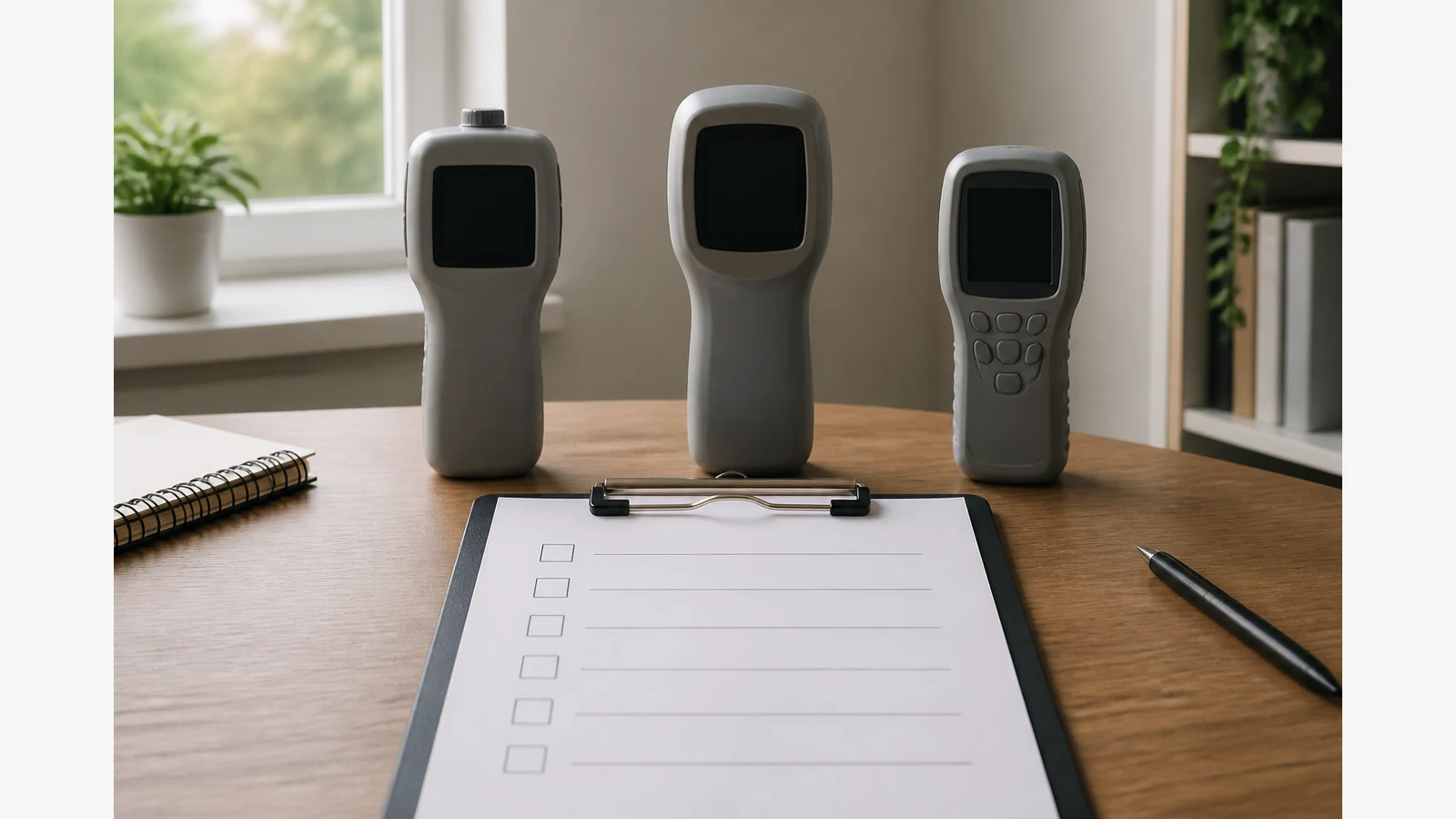
FNIRSI vs Hantek Handheld Oscilloscope UK: How to Compare Specs Honestly
UK buyers comparing entry handhelds often see similar megahertz numbers and still feel unsure which listing is more honest. A practical FNIRSI vs Hantek handheld oscilloscope UK decision is not about crowning a lab winner—it is about checking functions you can verify, documentation you can read, and support cues you can use if the unit disappoints.
Direct answer: stop comparing MHz in isolation
Headline bandwidth is only useful after you confirm channels, sample behaviour claims, meter integration, generator presence, probe quality and whether the seller’s UK page explains limits clearly. UK-facing comparison content commonly frames FNIRSI as multifunction/portable value and Hantek as often stronger on dedicated or bench-oriented bandwidth options—treat that as a starting map, not a scoreboard.
Decision table for entry handhelds
| Check | Why it matters | What “good” looks like |
|---|---|---|
| Portability | Field and desk clutter | True handheld weight/size; rechargeable; English UI |
| 3-in-1 integration | Total kit cost and bag weight | Scope + True RMS meter + usable generator stated clearly |
| Bandwidth honesty | Avoid overstated marketing | Bandwidth paired with realistic use cases, not miracle claims |
| Channels | Compare two signals | Dual channel for learning and fault-finding |
| UK stock / returns | Risk if specs disappoint | Clear delivery, returns window, readable warranty notes |
| Documentation | Learning curve | Readable specs, safety category, limitations in plain English |
Common buyer traps
- Nearly identical MHz claims with missing sample or memory detail
- “Oscilloscope multimeter” labels that omit a usable signal generator
- Screenshots that look professional while the listing hides CAT markings
- Imported marketplace pages with weak UK returns language
- Assuming any 10 MHz single-channel 3-in-1 is identical—UK stock listings show strong demand for this class, but build quality and documentation still vary
Where a balanced ZT-702S-class 3-in-1 fits
See the ZOYI ZT-702S on the product page. When you put this listing next to a FNIRSI or Hantek page, compare the same kinds of facts. Channel count, bandwidth, sample rate, meter counts, what the box actually contains, and whether the voltage limit is printed where you can see it. The instrument ScopeMeter sells is the ZOYI ZT-702S. One oscilloscope channel at 10 MHz, 48 MS/s sampling, and a 9999-count True RMS meter. The screen is a 2.8-inch colour panel. The body is 177 by 89 by 40 mm. Charging is USB-C into an 18650 cell. A spare oscilloscope probe set is included with this English-menu version. The square-wave port is fixed at 3 V and 1 kHz so you can compensate the probe. A bench generator with a menu of waveforms is a different instrument. If the other listing will not put channel count and bandwidth in the same sentence as the model, leave it and use the specification you can check. On the ZT-702S that sentence is one channel, 10 MHz, 48 MS/s, 9999-count True RMS, USB-C charging, and a spare probe set. The live price on the product page is £98.46 including VAT, with UK delivery and a 30-day returns note. Scope input stays within 150 V peak. Do not treat a marketplace screenshot of a 10 MHz single-channel unit as the same object. Ask the rival listing the same questions: how many channels, what bandwidth, which probes, which voltage limit, and who handles the return. Then read our product page, where the price is £98.46 including VAT until that page changes. A fair comparison also includes the bag. One handheld with a spare probe is easier to carry than a scope, a meter and a lead case. It is the wrong choice if your fault only shows up when two waveforms are on screen at once, or if you need to inject a sine sweep. For sensor checks, PWM, and low-voltage board work, write down the signal you expect, set the timebase so two or three cycles fill the screen, and confirm the amplitude with the meter before you condemn a part. A useful scorecard has six lines: channels, bandwidth, sample rate, meter counts, probes in the box, and the scope input limit. Fill it for the ZT-702S and for the other model before you look at the photos. Photos hide whether the second channel is real and whether the generator is a fixed compensation port. On this meter the port is fixed at 3 V and 1 kHz. Say that out loud when you compare, so a six-waveform generator on another brand stays a different feature. Then compare returns. A clear UK page with a 30-day window is part of the tool, part of the comparison itself. If the rival page will not state the bandwidth and the channel count in the same sentence as the model name, treat the listing as unfinished and come back to the specification you can read.ZT-702S product page side by side with the rival listing you were about to buy.
Who should pick a dedicated Hantek (or other) bench unit instead
Choose a dedicated bench scope when you need larger displays, deeper memory, advanced triggering or classroom/lab workflows. Multifunction handhelds trade peak instrument performance for portability and kit reduction. That trade is rational for makers, field LV work and general electronics—not for RF labs.
Related guides
If your real question is kit economics, read 3-in-1 versus buying three instruments. If you are starting from microcontroller projects, see oscilloscope for Arduino UK.
FAQ
What do “honest specs” mean in practice?
Specifications you can reconcile with the product page, safety category, and realistic use cases—without inventing accuracy percentages or silent protocol-decoding features.
Do UK returns matter for handheld scopes?
Yes. A clear returns window lets you verify screen readability and basic functions at home; prefer sellers who state delivery and returns in plain English.
Should I buy on MHz alone?
No. Channels, integration, documentation and support usually decide whether the tool earns a place in your bag.