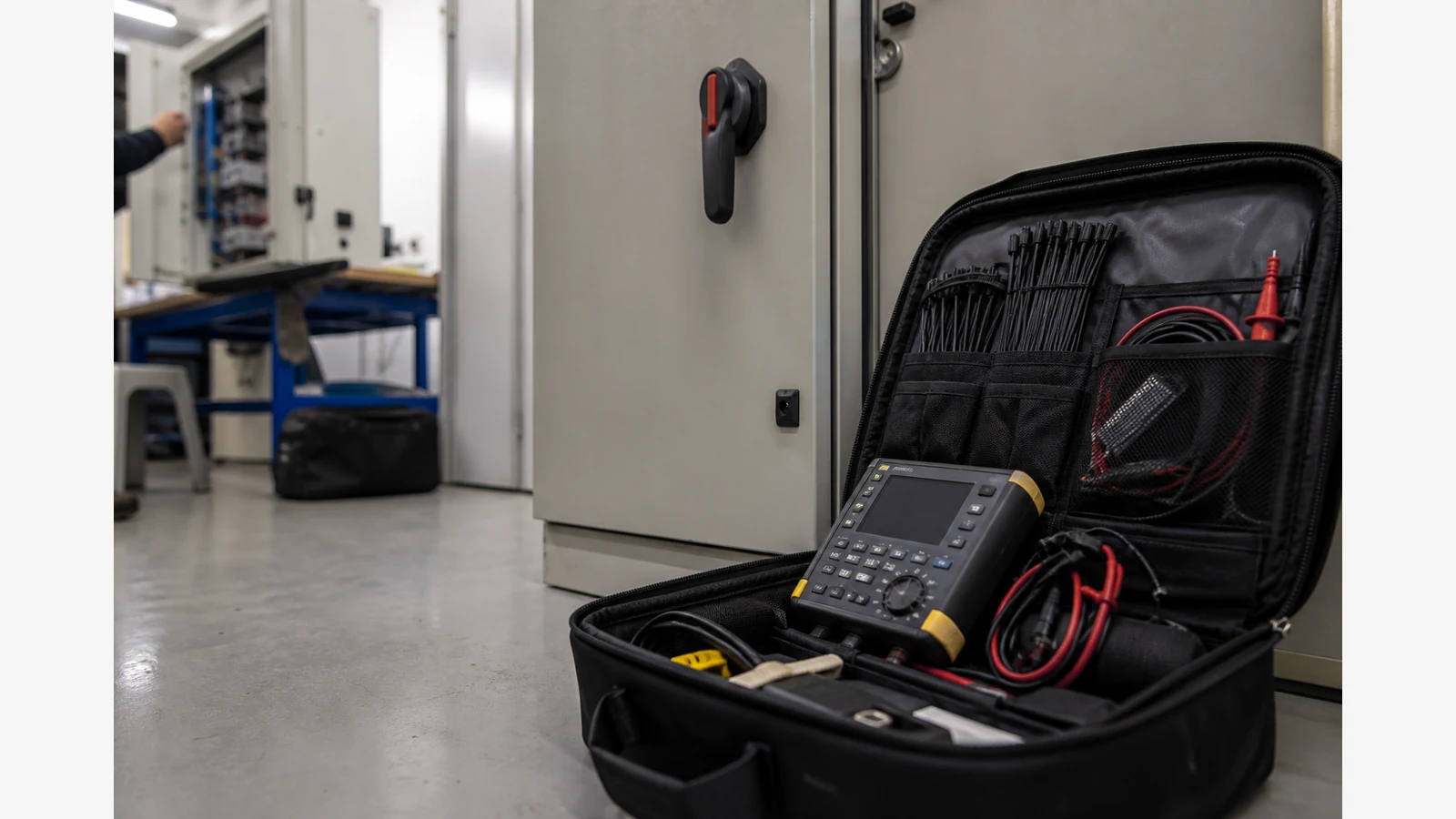
Portable Oscilloscope for Field Service UK: Pack Less, Diagnose Faster
When the fault is on site, a benchtop oscilloscope stays in the workshop. A portable oscilloscope for field service UK engineers need something that fits a van kit, survives cabinet work and still shows a waveform after the multimeter has narrowed the search. The practical answer for routine low-voltage diagnostics is a compact handheld that combines metering and scoping—so you carry fewer boxes without pretending you own an industrial ScopeMeter.
What actually matters in a UK van kit
Portability, on-site diagnostics and battery life are the buying criteria professional guides emphasise for handheld scopes used in the field. Translate that into UK day-to-day constraints:
- Weight and size: Pocketable units around a few hundred grams keep the bag lighter than a separate DMM, scope and generator.
- English UI and rechargeable power: You need to work without hunting for a mains outlet in every plant room.
- CAT markings you will respect: Know the stated category limits and stay inside them.
- One-tool workflow: Voltage and continuity first, then a quick waveform check on the same instrument.
A repeatable on-site sequence
- Meter first: Confirm supply presence, polarity and continuity before connecting scope probes.
- Waveform second: Capture the suspect node; use dual channel when comparing input versus output or drive versus feedback.
- Inject only if appropriate: A built-in signal generator can help functional tracing on safe, isolated low-voltage paths—never as a substitute for isolation practice.
- Document and stop: Photograph the screen, note conditions, and escalate when the job exceeds the tool’s category or bandwidth.
3-in-1 kit reduction versus separate instruments
Carrying a discrete True RMS multimeter, a portable scope and a generator multiplies chargers, leads and failure points. A single handheld that integrates all three reduces clutter for routine LV visits—the same reason field reviews often praise one portable unit for voltage, continuity and quick waveform inspection. That does not make the combo equal to premium separate instruments; it makes the kit lighter for everyday faults.
When you still need an industrial ScopeMeter-class tool
Industrial portable ScopeMeters exist for a reason. Rugged plant and maintenance instruments in that class set the aspirational bar UK buyers compare against for harsh environments, higher channel performance and demanding category work. Do not treat a budget handheld as equivalent to those tools, and do not use a compact unit for CAT IV or high-energy plant tasks outside its markings.
Safety note: Stay within the instrument’s published measurement category. Compact handhelds aimed at electronics and routine LV diagnostics are not a licence for open high-energy panels or work beyond your competence and PPE requirements.
Next step for routine LV diagnostics
See the ZOYI ZT-702S on the product page. Field service rewards the tool you will actually carry. A separate scope, meter and generator stays in the workshop because the case is heavy and one lead is always missing. The ZOYI ZT-702S is one handheld for the waveform and the reading. Single 10 MHz channel, 48 MS/s, 9999-count True RMS, 2.8-inch colour screen, English menus, USB-C charging, body 177 by 89 by 40 mm, and a spare probe set in the box. Before the first call of the day, compensate the probe on the fixed 3 V / 1 kHz port. On site, use the meter to prove the supply and the scope to see whether a control signal is present. Keep the scope input within 150 V peak. Do not use the square-wave port as a way to force a live industrial circuit. It is there to check the probe. If the fault needs two waveforms at once, or a bandwidth well above 10 MHz, or a category the meter does not carry, stop and bring the right instrument. Charge the cell overnight. A dead handheld is just weight. The live price is £98.46 including VAT, with the returns notes on the product page. Write the model in the job sheet as ZT-702S so the next visit matches the tool you used, and so nobody later assumes a dual-channel 50 MHz generator was on the van. Make a two-minute check part of packing the van. Battery charged, spare probe in the pouch, square-wave port still a square, and the model written on the job sheet as ZT-702S. On arrival, meter first for the supply, scope second for the control signal, and only on points inside 150 V peak. If the trace is absent, prove the ground and the connector before you change a board. If the call needs two channels or a higher bandwidth, say so and fetch that instrument rather than stretching this one. The 2.8-inch screen is readable in a plant room if you stand so the light is behind you. USB-C charging overnight is what keeps the afternoon calls possible. The price on the product page is £98.46 including VAT until that page changes. Leave the spare probe in the pouch, not loose in the tray. A second lead is what saves the second call of the day when the first ground clip fails. Record the model, the channel you used, and the voltage limit you stayed inside.ZT-702S handheld ScopeMeter for size, CAT markings and integrated meter functions. Related reading: buy one kit or three and measuring power-supply ripple on the bench.
FAQ
How long will the battery last?
Treat runtime as job-dependent. Prefer rechargeable lithium handhelds you can top up between visits; avoid trusting unverified hour claims in marketing copy.
Can I probe UK mains with a compact handheld?
Only within the published CAT rating, with correct probes and training. If the task exceeds the tool or your authorisation, stop and escalate.
Is a 3-in-1 enough for every field call?
No. It suits routine LV diagnostics. Complex plant, deep memory captures or Category IV environments need tools purpose-built for that work.