Lux Multimeter Explained: A UK Buyer's Guide
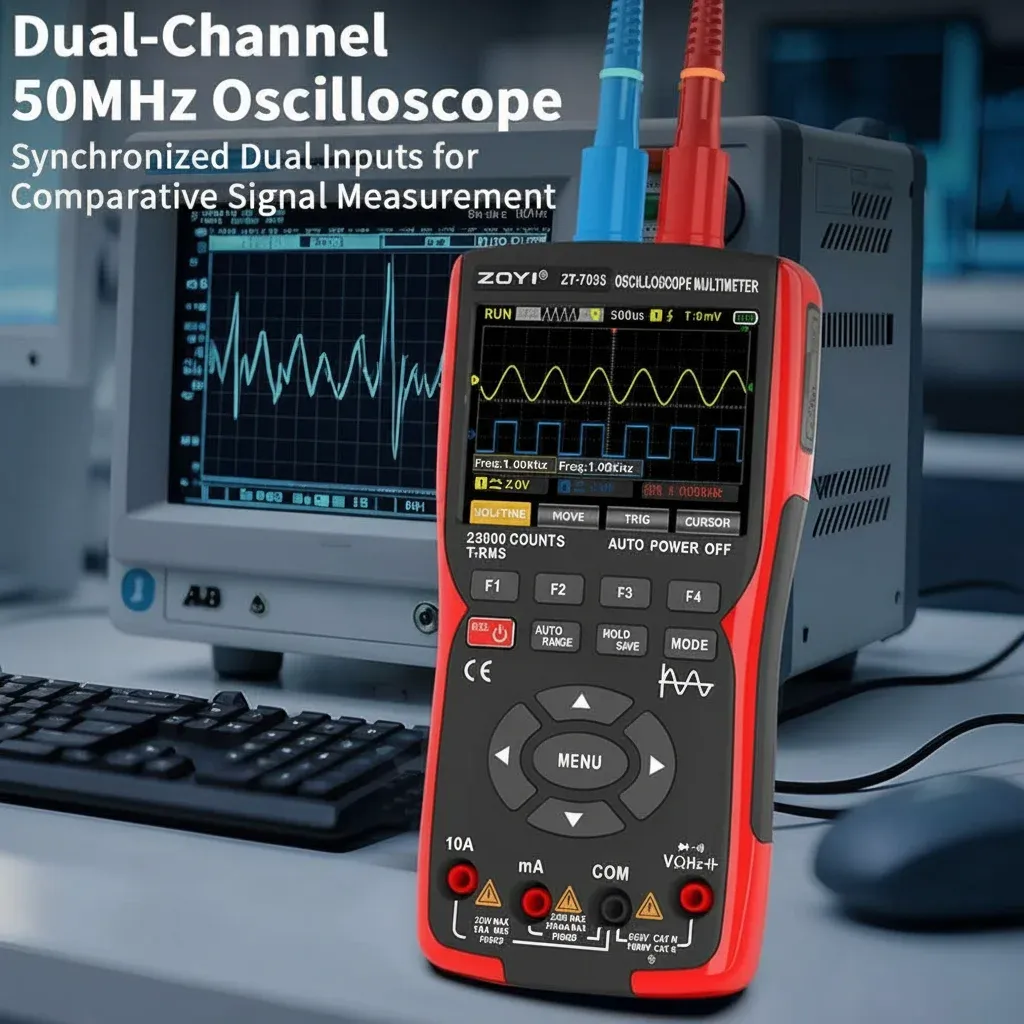
In the precision-driven world of electrical diagnostics, the ability to measure more than just voltage or resistance is becoming a standard requirement for UK field engineers. A lux multimeter represents a sophisticated evolution in handheld testing, combining traditional electrical measurement with light intensity sensing. For professionals maintaining commercial offices, NHS facilities, or industrial warehouses, this 3-in-1 capability—integrating a multimeter, an oscilloscope, and a light meter—streamlines workflows and ensures compliance with stringent British safety standards.
Key Takeaways
- All-in-One Efficiency: A lux multimeter eliminates the need to carry separate light meters and electrical testers, ideal for UK site inspections.
- Regulatory Compliance: Essential for verifying adherence to HSE lighting guidelines and BS EN 12464-1 standards for indoor workplaces.
- Versatility: Useful across diverse sectors including facility management, horticulture, photography, and emergency lighting maintenance.
- Precision Sensors: Look for silicon photodiode sensors with cosine correction for accurate readings in varied environments.
Whether you are investigating a flickering LED driver or verifying that a newly commissioned office space meets CIBSE (Chartered Institution of Building Services Engineers) recommendations, the lux multimeter is an indispensable asset. By housing these functions within a single, portable unit like the ScopeMeter, engineers gain the "multimeter power" needed for complex electronics, automotive faults, and field diagnostics without the bulk of multiple devices.
Understanding the Lux Multimeter
At its core, a lux multimeter is a digital multimeter (DMM) equipped with a light-sensitive sensor, typically a silicon photodiode. This sensor converts light energy into an electrical signal, which the device then processes and displays as a "lux" value. One lux is equivalent to one lumen per square metre. In the UK, this metric is the standard for quantifying the amount of light hitting a surface, distinct from "lumens," which measure the light emitted at the source.
Integrating light measurement into a diagnostic tool is particularly beneficial when troubleshooting systems where electrical performance directly impacts environmental conditions. For instance, in smart building maintenance, a technician might use the oscilloscope function of a ScopeMeter to check the pulse-width modulation (PWM) signal of a dimming circuit, while simultaneously using the lux function to verify the actual light output. This synergy is explored further in our UK buyer's guide to multimeters.
The Science of Light Measurement
The accuracy of a lux multimeter depends on its spectral response and cosine correction. The human eye does not perceive all colours (wavelengths) with equal sensitivity; it is most sensitive to green-yellow light. High-quality lux multimeters use filters to match the CIE (Commission Internationale de l'Éclairage) photopic curve. Furthermore, cosine correction ensures that light hitting the sensor at an angle is measured accurately, preventing the "cosine error" that occurs when light is only measured from a direct, perpendicular source.
The UK Regulatory Landscape: Why Lux Measurement is Critical
In the United Kingdom, lighting is not merely a matter of aesthetics; it is a legal and safety requirement. The Health and Safety Executive (HSE) outlines specific lighting levels required for different tasks to prevent accidents and health issues such as eyestrain or migraines. According to HSE research, poor lighting is a contributing factor in thousands of workplace "slips, trips, and falls" annually, a category of accident that costs UK businesses over £500 million per year in lost productivity and compensation.
"Lighting should be sufficient to enable people to work, use facilities, and move from place to place safely and without experiencing eye strain." — HSE Lighting at Work (HSG38).
For facility managers, using a lux multimeter is the most efficient way to document compliance with these regulations. During a routine electrical safety check, a technician can quickly pivot from testing a socket-outlet to verifying that an emergency exit route meets the minimum 1-lux requirement. This multifunctional approach is a hallmark of the non-digital multimeter and digital multimeter integration found in modern diagnostic kits.
CIBSE and British Standards
Beyond basic safety, the BS EN 12464-1 standard provides detailed recommendations for lighting in indoor workplaces. For example, a standard UK office environment typically requires a maintained illuminance of 500 lux at the task area. In contrast, precision assembly lines or surgical theatres within the NHS may require 1,000 lux or higher. A lux multimeter allows for the rapid auditing of these spaces, ensuring that lighting levels have not degraded over time due to "lumen depreciation" in ageing bulbs or dust accumulation on fixtures.
Key Applications for Lux Multimeters in the UK
1. Commercial Facility Management
The primary use case in the UK is the maintenance of commercial real estate. With the rise of "Green Building" certifications like BREEAM, companies are under pressure to balance adequate lighting with energy efficiency. A lux multimeter helps technicians calibrate daylight harvesting systems, where artificial lights dim automatically when natural sunlight is sufficient. By measuring the lux levels at desk height, engineers can ensure that energy-saving measures do not compromise worker comfort.
2. The NHS and Healthcare Environments
In hospital settings, lighting plays a vital role in patient recovery and staff performance. Specific lux levels are mandated for wards, corridors, and treatment rooms. A technician using a ScopeMeter can diagnose a faulty ballast in a ceiling light and then immediately verify that the replacement unit provides the correct illuminance, all without returning to the tool store for a dedicated light meter.
3. Horticulture and "Grow" Environments
The UK's burgeoning vertical farming and hydroponics sector relies heavily on precise light measurement. Different plants require specific "Photosynthetically Active Radiation" (PAR) levels, but lux remains a useful proxy for general intensity. Using a lux multimeter allows growers to map the light distribution across a greenhouse, identifying "dark spots" that could lead to uneven crop yields.
4. Photography and Cinematography
While professional photographers often use dedicated light meters, the lux multimeter is a popular "backup" tool for set technicians and gaffers. It allows for the measurement of "incident light" to ensure consistent exposure across different camera angles, especially in the high-pressure environment of UK film studios.
What to Look for in a UK Lux Multimeter
When selecting a device, it is important to distinguish between a "toy" and a professional-grade diagnostic tool. For the UK market, where precision and durability are paramount, consider the following specifications:
- Measurement Range: Ensure the device can measure from low levels (0.1 lux for emergency lighting) up to at least 40,000 or 50,000 lux for bright daylight conditions.
- Auto-Ranging: This feature allows the device to automatically select the best resolution for the light level being measured, preventing "over-range" errors.
- Data Hold and Peak Capture: Essential for recording measurements in awkward positions, such as under a desk or near a high-mounted fixture.
- Build Quality: In the UK, field tools are often subjected to damp conditions and physical knocks. Look for an IP-rated housing or a ruggedised exterior, typical of the ScopeMeter design.
- Calibration Certification: For professional compliance work, the device should be capable of being calibrated to UKAS (United Kingdom Accreditation Service) standards.
If your work involves high-current applications alongside light measurement, you might also consider how a lux multimeter compares to a multimeter clamp, which is specialised for non-contact current measurement but often lacks integrated light sensors.
Integrating Lux Measurement into Your Diagnostic Workflow
The true power of the lux multimeter lies in its integration. Imagine a scenario in a UK manufacturing plant where a machine's optical safety sensor is frequently tripping. A technician using a standard multimeter might only check the power supply to the sensor. However, an engineer equipped with a 3-in-1 ScopeMeter can:
- Use the multimeter to check the DC voltage at the sensor terminals.
- Use the oscilloscope to look for noise or interference on the signal line.
- Use the lux meter function to determine if ambient factory lighting is interfering with the sensor's optical path.
This holistic approach reduces "mean time to repair" (MTTR) and prevents the "parts cannon" approach to maintenance, where components are replaced unnecessarily because the root cause—environmental light interference—was never measured.
Equip Yourself with the Ultimate 3-in-1 Diagnostic Tool
Stop carrying multiple devices. Experience the "multimeter multimeter power" of the handheld ScopeMeter. Perfect for UK electronics, automotive faults, and comprehensive field diagnostics.
Frequently Asked Questions
Can I use a lux multimeter to measure LED lighting?
Yes, most modern lux multimeters can measure LED light. However, because LEDs produce light in specific spectral peaks, ensure your meter is "LED corrected" or has a broad enough spectral response to capture the full output of white LEDs accurately.
How often should a lux multimeter be calibrated?
For professional use in the UK, especially when documenting safety compliance for the NHS or large corporations, annual calibration is recommended. This ensures the silicon photodiode has not drifted and that your readings remain accurate to British Standards.
What is the difference between Foot-candles and Lux?
Lux is the metric unit (lumens per square metre), while foot-candles is the imperial unit (lumens per square foot) used primarily in the United States. 1 foot-candle is approximately 10.76 lux. Most professional multimeters sold in the UK allow you to toggle between these units, but Lux remains the standard for UK building regulations.
Is a lux multimeter as accurate as a standalone lux meter?
While high-end standalone meters are specialised for laboratory-grade accuracy, a professional-grade lux multimeter provides more than enough precision for 95% of field applications. The convenience of having light measurement integrated with a 3-in-1 oscilloscope and multimeter far outweighs the marginal accuracy gains of a standalone unit for most UK engineers.
Ready to try ScopeMeter?
Shop Now — £19.99