Handheld Oscilloscope for Car Sensors UK: DIY Low-Voltage Checks
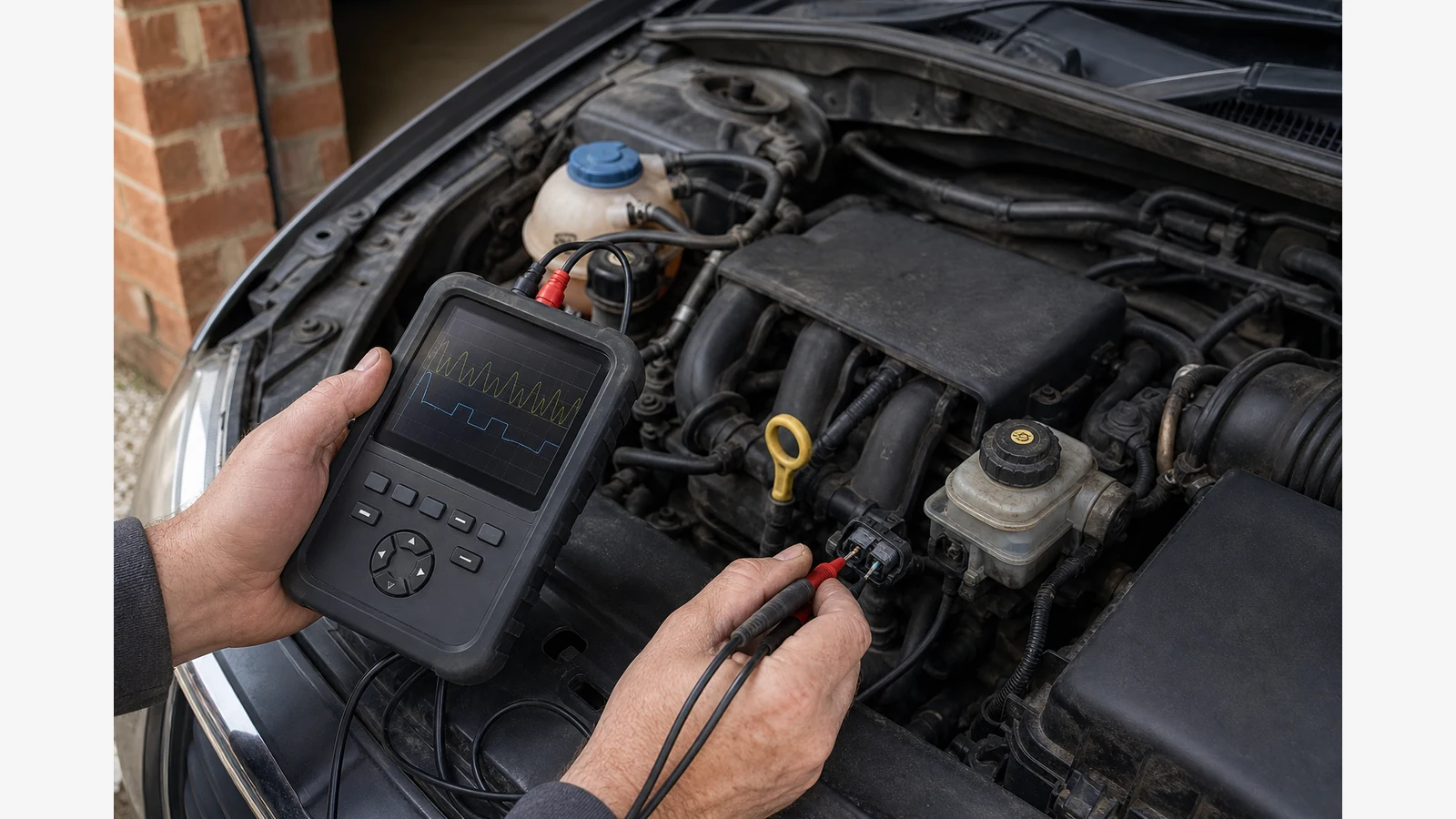
A fault code names a circuit; it does not prove the sensor signal is healthy. UK trade guidance on oscilloscope diagnostics explains why waveform checks matter for sensors and vehicle signals that a scan tool alone cannot settle. For careful DIY owners, a handheld oscilloscope for car sensors UK use is about low-voltage presence and shape checks on 12 V systems—not high-voltage EV work and not a promise to catch every intermittent glitch.
Why codes are not enough
Many sensor faults are intermittent, clipped or noisy. A code reader may report “circuit range/performance” while the waveform shows dropouts, slow rise times or a stuck level. DIY owners on UK forums discuss entry handheld scopes precisely for budget sensor and injector waveform work—useful motivation, provided you stay inside safe boundaries.
Safe DIY boundary for UK home garages
- In scope: 12 V sensor supplies, signal wires where accessible, charging-system voltage behaviour on conventional vehicles, continuity and related meter checks.
- Out of scope: Hybrid/EV high-voltage systems, orange HV cabling, airbag circuits, and any work beyond the tool’s measurement category or your training.
Warning: Do not probe hybrid or EV high-voltage systems or airbag modules with a consumer handheld. Those jobs belong to qualified workshops with the correct isolation procedures.
Practical checklist for intermittent sensor signals
- Confirm battery state and relevant fuses with the meter first.
- Identify the sensor pinout from a trustworthy wiring diagram—never guess by colour alone.
- Back-probe carefully where connectors allow; avoid piercing insulation when possible.
- Use dual channel when comparing a reference (for example supply or crank reference) against the suspect signal.
- Watch for missing pulses, flatlines, noise bursts or amplitude that collapses under load/heat.
- Reproduce the fault condition (heat, wiggle test, road-speed equivalent on a safe ramp) without creating a hazard.
- Stop if the waveform is inconclusive or the circuit is safety-critical—book a garage with a Pico-class kit and known-good libraries.
What a handheld can confirm—and what it cannot
A single-channel 10 MHz handheld can help confirm whether a low-voltage sensor waveform is present, toggling and roughly the right shape for everyday checks. A True RMS multimeter in the same unit helps with related voltage and continuity. It will not match professional automotive scope libraries, guided tests or deep capture workflows. Reviews that mention intermittent signal capture on automotive sensors are encouraging—not a guarantee you will catch every glitch.
If you want meter and scope in one tool
Homeowners who already own a code reader often benefit most from adding waveform visibility without buying a full PC scope kit on day one. See the ZOYI ZT-702S on the product page. On a car, the useful split is simple. The meter tells you whether the supply is there. The scope tells you whether a low-voltage sensor trace is alive, stuck, or noisy. The ZOYI ZT-702S can do both, one after the other, from the same handheld. It is a single 10 MHz channel with 48 MS/s sampling and a 9999-count True RMS meter. That is enough to look at many cam, crank and throttle signals once you already know the expected shape from the workshop manual. It is the wrong tool for high-voltage ignition secondary and for any point above the scope input limit of 150 V peak. Charging-system voltage belongs on the meter ranges, and you still compare the number with the vehicle maker's figure. English menus and a 2.8-inch colour screen make it usable in a driveway. USB-C charging and a spare probe set matter when the first lead gets oil on it or the clip breaks. Compensate the probe on the fixed 3 V / 1 kHz port before you trust a small sensor amplitude. Match X1 or X10 on the probe and in the meter. Ground the scope reference only at a point the manual allows. If the waveform is missing, check the connector and the supply with the meter before you replace the sensor. The live price is £98.46 including VAT. Read the product page for the returns window before the tool lives in the van. Complex plant, airbag circuits and any job outside your authorisation still stop at the meter and go to the right procedure. Before you open the bonnet, decide which point is a meter job and which point is a scope job. Battery and charging voltage are meter jobs. A sensor that should rise and fall as you move the pedal is a scope job, and only while the voltage stays inside 150 V peak. Set the timebase so you can see the repeat, then freeze the screen and write the setting in the job notes. If the trace is noisy, shorten the ground lead before you replace the sensor. The spare probe is for the moment the first ground clip is lost in the engine bay. English menus matter when you are reading the range outdoors. When the manual gives a frequency or a pulse width, compare what you see with that figure and stop if the access needs a dealer tool. The handheld shows the signal you clipped to. It does not invent the workshop procedure.ZT-702S product page. For alternator-side metering context see how to test an alternator with a multimeter, and for kit strategy see the 3-in-1 buying guide.
FAQ
Is the safety category enough for car work?
Respect the instrument’s CAT markings and treat vehicle work as low-voltage DIY only when you understand the circuit. Category labels do not authorise HV or airbag probing.
Can I use this on hybrids and EVs?
No for high-voltage systems. Leave HV diagnostics to qualified technicians.
When should I not probe?
If you lack a diagram, cannot access the connector safely, suspect an airbag/HV circuit, or the fault is safety-critical—stop and use a professional workshop.