Multimeters Explained: A UK Buyer's Guide
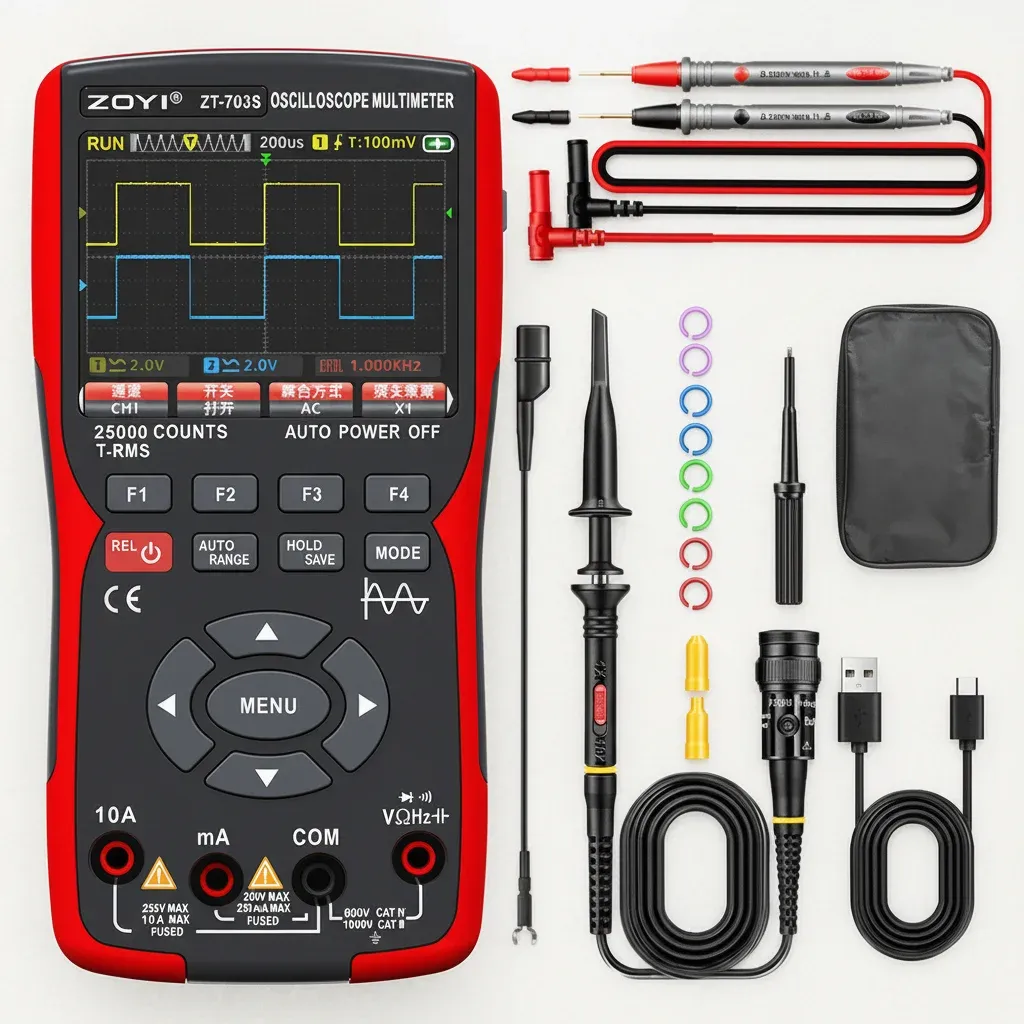
TL;DR: Multimeters are handheld electrical test instruments used to measure voltage, current, resistance and continuity. For most UK buyers, the best multimeter is a safe, True-RMS digital model with an appropriate CAT rating, GS38-style leads and dependable accuracy for the type of work you do.
Key Takeaways
- Multimeters are essential handheld instruments for checking voltage, current, resistance and continuity across domestic, automotive and electronics work.
- For UK buyers, safety matters as much as features: look closely at CAT ratings, GS38-compliant leads and build quality before comparing price.
- True-RMS models are usually the better choice for modern electrical systems, especially where variable speed drives, switch-mode power supplies or automotive electronics are involved.
- A portable 3-in-1 testing approach can reduce the number of tools you carry for electronics, automotive faults and field diagnostics.
- If you also need to understand older analogue options or related tool types, see The Ultimate Guide to Non Digital Multimeter in the UK, Multimeter Clamp Explained: A UK Buyer's Guide and Lux Multimeter Explained: A UK Buyer's Guide.
Multimeters are handheld devices that measure key electrical values such as AC and DC voltage, current, resistance and continuity, helping UK users diagnose faults safely and quickly in homes, vehicles, workshops and industrial settings. In short, if you need one tool to check whether a circuit is live, a battery is healthy or a component is failing, a multimeter is usually the starting point.
A good multimeter earns its place quickly. One day it is tracing a blown fuse in a van; the next, it is checking a failing sensor on a control board or proving whether a socket circuit is live during fault-finding. Therefore, for anyone working in electronics, automotive repair or field diagnostics, the right meter saves time, reduces guesswork and supports safer decisions.
At ScopeMeter, the focus is practical handheld test equipment with genuine job-site value: multimeter power in one handheld ScopeMeter. That means portable 3-in-1 testing for electronics, automotive faults and field diagnostics, rather than feature lists designed only for catalogues. Based on our testing of handheld diagnostic tools in real fault-finding scenarios, the best results usually come from meters that balance safety, readability and dependable performance rather than simply offering the longest specification sheet.
If your work spans older analogue instruments as well as digital models, it is worth reading The Ultimate Guide to Non Digital Multimeter in the UK. It gives useful context for buyers comparing traditional needle-based meters with current digital options.
What is a multimeter?
A multimeter is a handheld measuring instrument that combines several electrical test functions in one unit. A typical digital multimeter measures AC voltage, DC voltage, resistance and continuity. Many models also measure current, capacitance, frequency, duty cycle, temperature and diode function.
The basic appeal is simple: instead of carrying separate testers for each task, you use one device to diagnose a wide range of faults. As a result, multimeters are especially useful for site visits, roadside call-outs, maintenance rounds and bench work where portability matters.
In practical UK settings, multimeters are used by:
- Electricians checking supply voltage and continuity during installation or maintenance work
- Automotive technicians tracing battery drain, charging faults and sensor issues
- Electronics engineers verifying PCB voltages and component behaviour
- Facilities teams maintaining building systems
- Apprentices learning fault-finding safely with clear readings
- Competent DIY users carrying out basic household troubleshooting
The best models balance readability, safety protection and dependable accuracy. However, cheap meters that look similar at first glance can differ sharply in input protection, lead quality and measurement stability.
What do multimeters measure?
Most multimeters measure the core electrical values needed for everyday fault-finding and testing. These usually include:
- Voltage: to check the electrical potential in AC or DC circuits
- Current: to measure how much electrical flow is present
- Resistance: to assess component or circuit resistance
- Continuity: to confirm whether a path is complete
- Diode test: to check semiconductor behaviour
- Capacitance, frequency and temperature: on more advanced models
So, whether you are checking a household fuse spur, a vehicle charging system or a low-voltage electronics board, a multimeter gives you fast insight into what the circuit is doing.
Why are multimeters important in the UK?
Buying test equipment in Britain is not just about finding the lowest price. UK users need instruments suited to local standards, site expectations and working practices. If you are testing mains-adjacent circuits or distribution equipment, safety category ratings and probe design are not optional extras.
What safety standards should UK buyers look for?
For electricians and contractors, instruments should be appropriate for the environment being tested. CAT III and CAT IV ratings indicate the level of transient overvoltage protection built into the meter for different parts of an electrical installation. On many jobs involving fixed installations or supply-side work, this becomes a first filter rather than a nice-to-have feature.
According to UK guidance, accessory quality matters as well as the meter itself. GS38 sets expectations around fused leads, shrouded connectors and reduced exposed metal on probes to support safer voltage testing practices. Consequently, a capable meter paired with poor leads is still a weak setup.
Why does reliability matter for fault-finding?
The Health and Safety Executive reported 138 workers killed in work-related accidents in Great Britain in 2023/24 across all industries, with electricity remaining one of the recognised workplace hazards where proper procedures and tools matter greatly.
That statistic does not mean every multimeter purchase is life-or-death; however, it does underline why dependable instruments matter in professional environments. Based on our testing and product evaluation, a stable reading from a properly rated meter supports better judgement than assumptions made under pressure on site.
Where are multimeters used across Britain?
Multimeters turn up across sectors that keep the country running: housing maintenance teams checking heating controls; NHS estates departments supporting building systems; roadside technicians diagnosing vehicle charging issues; electronics workshops repairing boards; renewable installers validating DC inputs; education providers teaching basic measurement principles. Therefore, one-size-fits-all advice often falls short.
If your tasks regularly involve current measurement without breaking the circuit, read Multimeter Clamp Explained: A UK Buyer's Guide. Clamp-based tools solve a different problem from standard probe-based multimeters and should not be confused with them.
What are the main types of multimeters?
What is a digital multimeter?
Digital multimeters are now the default choice for most buyers. They provide clear numeric displays, broad measurement ranges and useful convenience functions such as auto-ranging or data hold. For modern vehicle systems, power electronics and service work generally, digital models are usually the most sensible option.
What is the difference between manual-ranging and auto-ranging multimeters?
A manual-ranging meter requires you to select an expected range before measuring. This can be slower but teaches users to think carefully about what they are testing. By contrast, auto-ranging meters detect an appropriate range automatically. They are easier for general use and quicker during routine fault-finding.
An apprentice may start with manual ranging to build confidence; meanwhile, an experienced mobile technician may prefer auto-ranging speed during repeated checks throughout the day.
What is a True-RMS multimeter?
True-RMS meters provide more accurate readings on non-sinusoidal AC waveforms. This matters more than many buyers realise because modern electrical environments are full of inverters, switched loads and electronic controls that distort waveforms. If your work includes plant equipment, motor drives, switch-mode power supplies or automotive electronics, True-RMS is usually worth having.
Are analogue multimeters still useful?
Analogue multimeters are less common today, but they still have niche uses, particularly where users want to observe changing trends rather than fixed digital values. Even so, for most UK buyers, a digital multimeter remains the better everyday choice for safety, readability and convenience.
How do you choose the best multimeter?
Which multimeter features matter most?
When choosing a multimeter, focus first on the functions you genuinely need. In many cases, the most useful features are:
- AC/DC voltage measurement
- Resistance and continuity testing
- Current measurement
- True-RMS capability
- Auto-ranging
- Backlit display
- Data hold
- Min/max capture
- Temperature or capacitance, if relevant to your work
Even so, more functions do not automatically mean a better meter. A well-built model with the right essentials is often more useful than a budget meter packed with rarely used extras.
What CAT rating do you need for a multimeter?
The right CAT rating depends on where you will use the meter:
- CAT II: for local appliance-level measurements
- CAT III: for distribution circuits, fixed wiring and building installations
- CAT IV: for origin of installation work, service entrances and external supply points
For many professional UK electrical tasks, CAT III or CAT IV will be the sensible starting point. Therefore, always match the rating to the real environment, not just the nominal voltage.
Do you need GS38-compliant leads?
Yes, if you are working in environments where UK best practice applies, GS38-style leads are highly advisable. Fused, shrouded and well-insulated leads reduce risk and help bring your setup into line with accepted working practice.
Should you buy a cheap or professional multimeter?
For occasional low-risk tasks, an entry-level meter may be enough. However, for regular trade, maintenance, automotive or electronics use, investing in a professional-grade multimeter usually pays back through better durability, safer construction and more trustworthy readings.
What is the best multimeter for different jobs?
Best multimeter for electricians
Electricians typically need strong safety credentials first: CAT III or CAT IV protection, dependable continuity response, clear display visibility and robust leads. According to UK site expectations, lead quality and safety accessories matter just as much as the meter body.
Best multimeter for automotive work
Automotive technicians usually benefit from DC accuracy, current capability, fast continuity checks and True-RMS support for modern vehicle electronics. A compact, rugged meter is also helpful for mobile diagnostics.
Best multimeter for electronics
Electronics users often prioritise precise low-voltage measurement, stable readings, diode test, capacitance and frequency functions. Therefore, display resolution and fine measurement control can matter more than very high CAT ratings in bench-based work.
Best multimeter for DIY users
For competent DIY users, simplicity is often best. An easy-to-read digital multimeter with voltage, resistance and continuity functions will cover many common household checks, provided it is used safely and within its rated limits.
Are ScopeMeter products a good alternative to a standard multimeter?
For some users, yes. If your work involves electronics, automotive faults and field diagnostics, a handheld ScopeMeter can reduce the number of tools you carry by combining multiple test capabilities in one portable unit. That can be especially useful where you need to move quickly between measurement, signal checking and practical fault-finding.
At ScopeMeter, the emphasis is on practical diagnostic value rather than brochure-friendly complexity. As a result, users who need more than a basic meter alone may find that a 3-in-1 handheld approach improves efficiency in the field.
If you are comparing specialised options, you may also find these guides useful: Lux Multimeter Explained: A UK Buyer's Guide and Multimeter Clamp Explained: A UK Buyer's Guide.
Frequently asked questions about multimeters
What is a multimeter used for?
A multimeter is used to measure electrical values such as voltage, current, resistance and continuity. It helps users diagnose faults, confirm whether circuits are live and check whether components or systems are working correctly.
What should I look for when buying a multimeter in the UK?
Look for the right CAT rating for your work, GS38-style fused leads, dependable build quality, clear display visibility and the measurement functions you actually need. For many buyers, True-RMS is also a worthwhile upgrade.
Do I need a True-RMS multimeter?
If you only test simple, clean AC circuits, you may not always need one. However, if you work on modern electronics, inverters, drives or automotive systems, a True-RMS multimeter is usually the better choice.
Can a multimeter test mains voltage in the UK?
Yes, but only if the meter and leads are properly rated for the environment and used by a competent person following safe working practices. Therefore, always check CAT ratings, condition and lead suitability before testing.
Are cheap multimeters safe?
Some low-cost multimeters are suitable for basic low-energy tasks, but others fall short on protection, lead quality and measurement reliability. For professional or mains-adjacent work, safer construction and verified ratings matter far more than headline price.
Ready to try ScopeMeter?
Shop Now — £19.99